
Beat Advisor
Taking a music marketplace from an idea to a working product and brand
The Idea
Beat Advisor started with a simple observation: musicians want meaningful feedback from people they respect, but there is no easy or reliable way to get it. Most artists receive submissions through DMs, email, or personal connections. That experience is unstructured for everyone involved. Musicians do not know whether their track will be heard, and artists have no practical way to organize requests, provide thoughtful feedback, or get paid for their time.
I saw an opportunity to create a better exchange, one that could give emerging musicians direct access to experienced artists while giving those artists a professional way to manage and monetize their expertise.
What began as a business idea quickly became the most complete product challenge I had taken on. I was not designing one feature inside an existing system. I was defining the brand, the service, the customer experience, the product architecture, and the technology needed to make the whole idea work.
Defining the Experience
The first step was turning the idea into a clear product model. There are two sides to the marketplace, and each has a different definition of success.
Musicians need to feel confident that they are choosing the right person, understand exactly what they are paying for, and know what happens after they submit a track. Artists need control over their profile and pricing, enough context to give useful feedback, and a focused workflow for managing requests and getting paid.
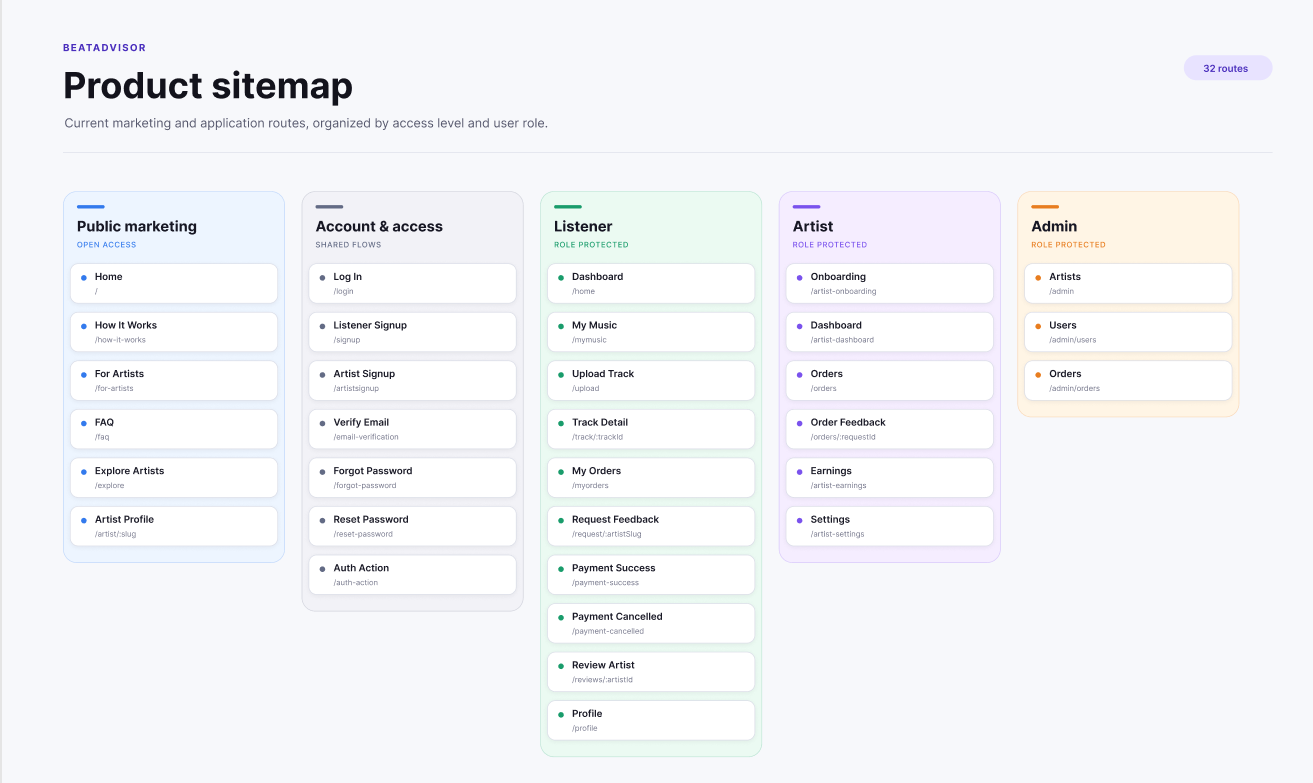
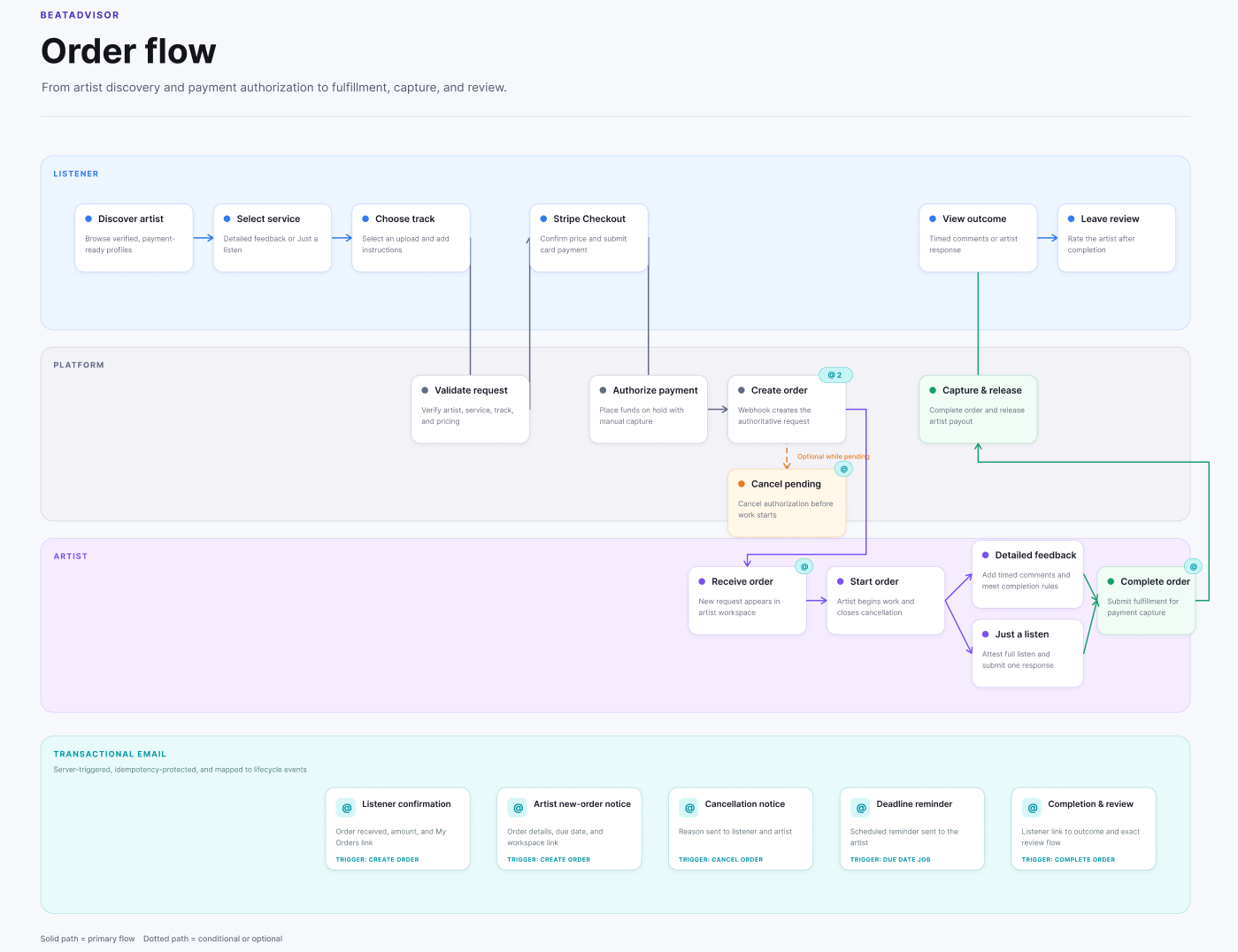
I mapped the complete journey for both sides, from discovery and onboarding through submission, payment, feedback, completion, and review. Looking at the experience as one connected service helped me find the moments where trust could break down and establish a few principles that guided the product:
- Keep the track at the center of the experience.
- Make the status of every request clear.
- Set expectations before money changes hands.
- Give each type of user a workspace built around their actual goals.
Building the Brand and Product
Because I was creating Beat Advisor from the ground up, the brand and product developed together. The identity needed to feel credible enough for established artists while still being approachable and energizing for musicians trying to move their work forward.
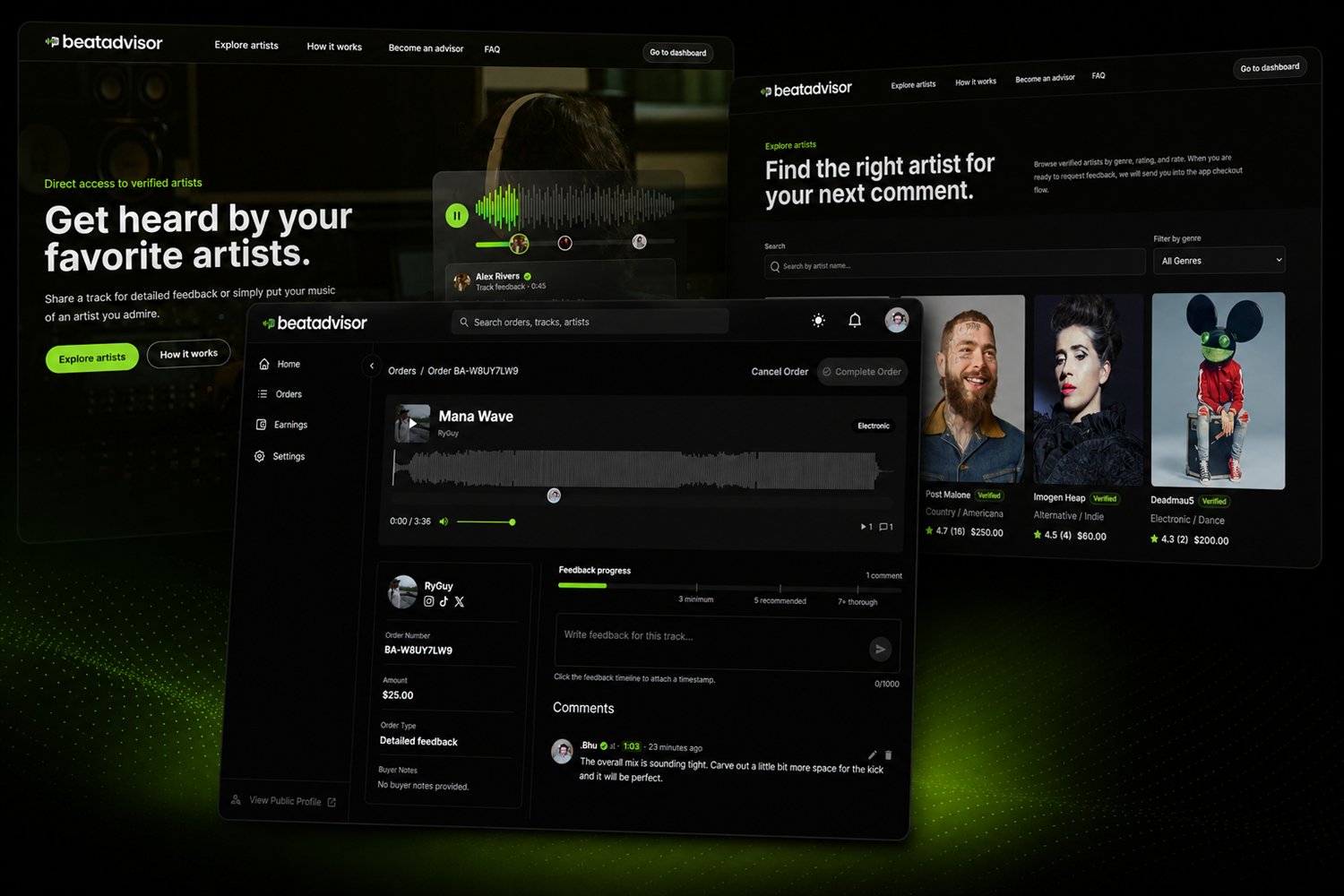
I developed the name, visual identity, messaging, and marketing experience alongside the application itself. That made it possible to carry the same idea through every touchpoint: direct access, useful guidance, and a clearer path forward for a track.
On the product side, I translated the service into three connected experiences:
- A listener experience for uploading music, discovering artists, requesting a service, tracking orders, and reviewing feedback.
- An artist experience for building a public profile, setting rates, managing requests, leaving feedback, and monitoring earnings.
- An administrative experience for reviewing artists and overseeing the marketplace.
I designed these workflows as parts of the same system rather than separate applications. A decision made in one experience, such as how an artist prices a service or completes an order, has to remain understandable everywhere else it appears.
Designing the Core Workflow
The waveform became the anchor for the product. Instead of delivering feedback as a long message disconnected from the music, artists can leave comments at specific moments in a track. Musicians can hear the exact section being discussed and understand the feedback in context.
Around that core interaction, I designed the supporting marketplace experience: artist discovery, public profiles, structured requests, protected payments, order states, reviews, notifications, and role-specific dashboards.
The artist orders dashboard is a good example of how I approached complexity. Artists need to understand what is open, what is due, how much feedback has been provided, what action comes next, and what they will earn. I brought those signals into one scannable view so the business can be managed without piecing information together across multiple screens.
I introduced two distinct services, Detailed feedback and Just a listen, to reflect different reasons a musician may want to reach an artist. The challenge was making those choices feel clearly different without creating two disconnected products.
Bringing It to Life
This project gave me the opportunity to use nearly every part of my background. I moved continuously between brand strategy, copywriting, user flows, interface design, prototyping, product decisions, and implementation.
My understanding of frontend systems helped me design experiences that could be built responsively and consistently. My growing knowledge of backend architecture helped me think beyond screens and account for authentication, permissions, data relationships, media storage, payments, notifications, and the lifecycle of an order.
Working across the full product also changed the way I designed. I could see immediately when a seemingly small interface decision created complexity somewhere else in the system. That feedback loop pushed me to simplify workflows, create reusable patterns, and make decisions with the entire service in mind.
I built the working product using a React interface, Firebase services, an Express backend, and Stripe for checkout and artist payouts. The technology matters, but the more important accomplishment was learning how to connect all of those pieces around a clear customer experience.
Outcome
Beat Advisor took me from designing within established products to creating an entire business and product ecosystem from a blank page.
It brought together the skills I had built across branding, visual design, UX, product strategy, and technology, and forced me to strengthen the connections between them. I learned how to move an idea forward when there was no existing roadmap, how to make decisions across both customer and business needs, and how to carry a concept all the way into a functioning product.
The result is more than a collection of screens. It is a working foundation for a new kind of music-feedback marketplace, with a brand, service model, product experience, and technical system designed to grow together.
Date
September 1, 2010