
Building a product health monitoring app from scratch
Problem
Customers often had difficulty diagnosing issues within their environments that could prevent successful deployment or impact the performance and maintainability of their products.
The information needed to identify these issues was complex and spread across multiple areas of the platform. Customers needed a way to quickly understand the overall health of their environment, identify potential problems, and determine what needed to be addressed.
Solution
I designed HealthCheck as an environment scanning and monitoring application that provides customers with a centralized view of their platform health.
The application evaluates an environment across several dimensions, including maintainability, upgradability, performance, security, and user interface, giving customers a clear understanding of potential issues along with actionable information to help address them.
The goal was to take a complex technical assessment and turn it into an experience that could be understood and acted upon without requiring users to navigate through multiple systems or manually interpret large amounts of information.
Strategy/Research
Working with product managers across a complex enterprise organization always presents an interesting challenge as a designer. Some projects begin with a clearly defined vision and detailed requirements, while others start with little more than a rough idea of what the product should accomplish.
That makes early alignment particularly important.
For HealthCheck, the overall vision and user pain points were already established, which allowed me to focus much of my time on the product architecture and overall experience. I worked closely with the PM to define the problem we were solving, establish scope and timeline, and collect the initial user stories and requirements.
Because HealthCheck was being built from the ground up and we were working within a tight timeline, I focused my research on understanding how similar products approached complex technical information and identifying patterns that could translate well to our users.
ServiceNow’s HealthScan was particularly useful as a reference point. It addressed many of the same challenges around evaluating the health of an enterprise environment and provided a useful conceptual foundation for exploring how HealthCheck could organize and communicate its findings.
The goal wasn’t to replicate an existing product, but to understand the patterns that worked and determine how they could be simplified and adapted for our users.
Design/Architecture
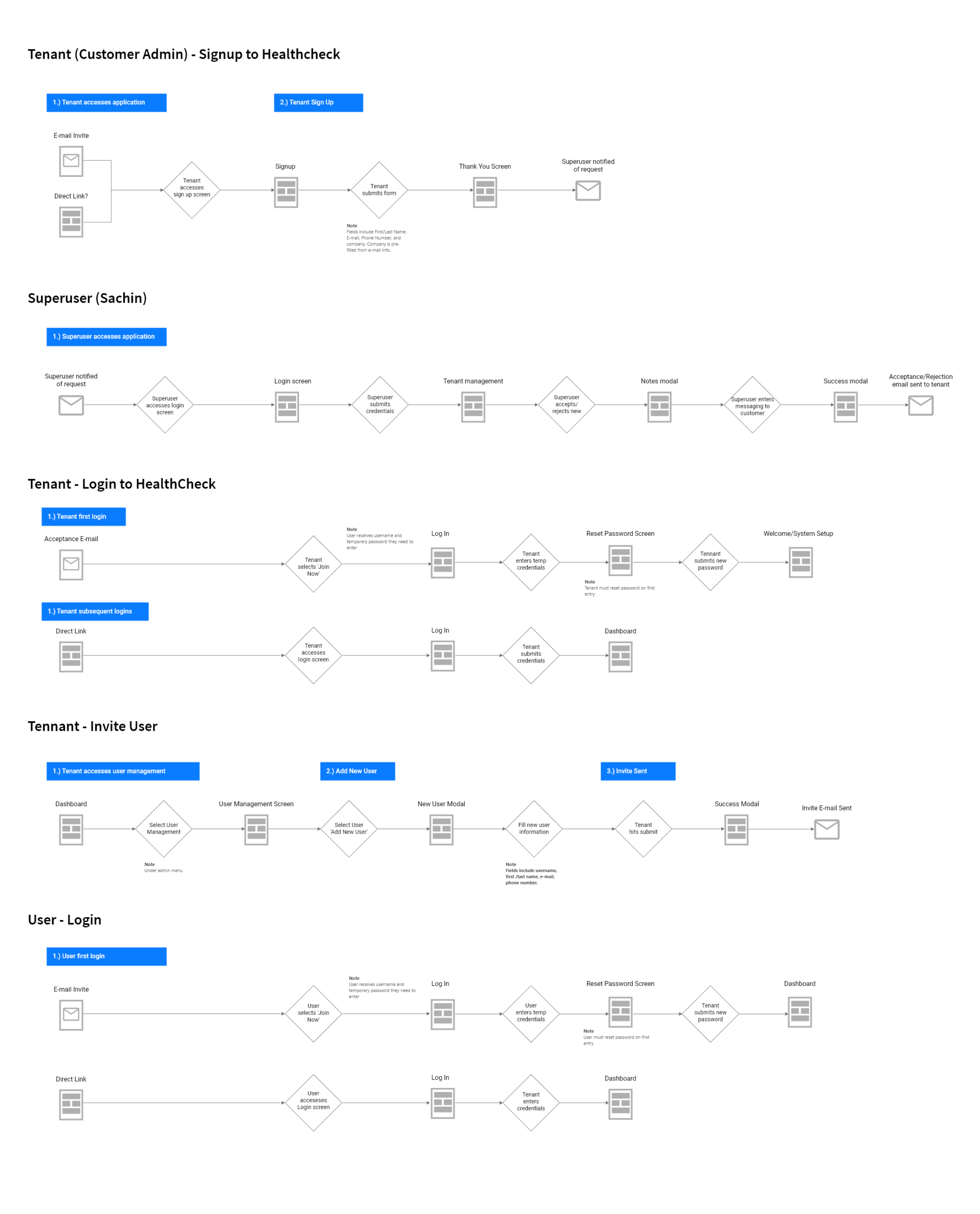
Once the requirements and initial information architecture were established, I began exploring different approaches for presenting the large amount of information HealthCheck needed to communicate.
Early concepts explored more traditional navigation structures, where users would move between different areas of the application to understand the health of their environment. As the designs evolved, it became clear that much of the experience could be consolidated into a single, well-structured dashboard.
This became one of the most important design decisions of the project.
Rather than making users navigate through the application to build an understanding of their environment, the dashboard could provide an immediate overview and allow users to progressively drill into areas that required attention.
The information hierarchy was designed around this principle: surface the most important information first, then provide deeper detail when the user needs it.
I iterated through multiple dashboard concepts with the PM and stakeholders, refining the hierarchy, organization, and interaction model until the primary use cases could be supported within a cohesive experience.
The resulting architecture gave users a clear starting point while still supporting the more detailed workflows required to investigate individual issues.
Final Design and Implementation
The final HealthCheck prototype centers around a dashboard that provides an at-a-glance view of an environment’s overall health.
Users can scan an existing environment and quickly understand the status of the products within it. When an issue is identified, the experience provides a path to drill into the underlying problem and understand what action may be required.
The interface was intentionally designed to make complex technical information easier to scan and understand. Clear status indicators, hierarchical information, and focused dashboard modules allow users to quickly distinguish between healthy areas and those requiring attention.
The MVP was successfully developed and began capturing data that could be used for future iterations and testing.
Outcome
HealthCheck established a foundation for proactively identifying issues within customer environments rather than requiring customers to discover problems after they affected deployment or product performance.
From a design perspective, the project demonstrated the value of simplifying complex technical information into a focused experience. What began as a broad set of requirements and potential workflows ultimately became a dashboard-driven product with a clear mental model and a scalable foundation for future capabilities.